Restored Property Access
Quickly regain access to driveways, clotheslines, entertaining decks, and rear yards.
Post-storm tree cleanup, hung limb removal, and insurance-ready arborist assessments in Hughes.
Servicing storm-affected properties across Hughes, Garran, Curtin, and Deakin
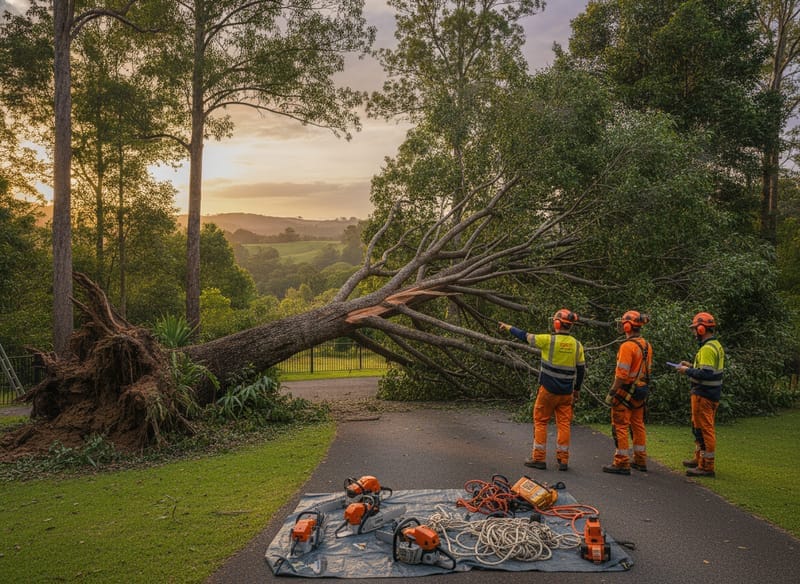
Storm damage tree removal Hughes delivers thorough post-storm recovery for residential and commercial properties. Following intense hail, heavy rain, or severe wind gusts, we clear fallen debris, prune torn branch collars, and assess remaining canopy stability.
Hughes frequently experiences severe convective storms and cold fronts sweeping across the ACT. The January 2020 hailstorm and recurrent westerly gales have left many brittle gums and mature deciduous trees with internal stress fractures that fail during storm events.
Quickly regain access to driveways, clotheslines, entertaining decks, and rear yards.
Remove broken limbs lodged overhead before they fall during everyday breezes.
Cleanly prune jagged tear-outs so surviving trees can compartmentalise wounds and recover.
We inspect all storm-affected trees across your Hughes block, prioritizing active structural hazards.
We provide a clear quotation and, if required, an arborist report for your insurance provider.
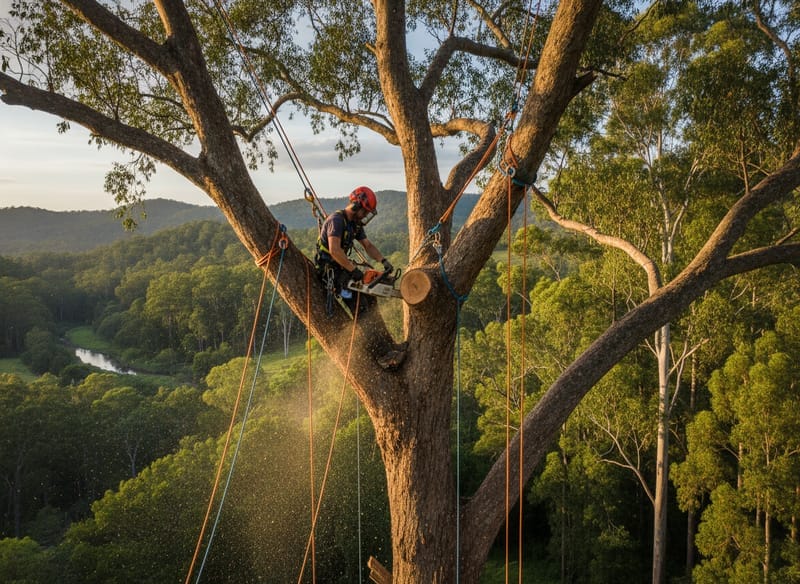
Our climbers ascend to remove hung-up limbs and relieve tension on partially split stems.
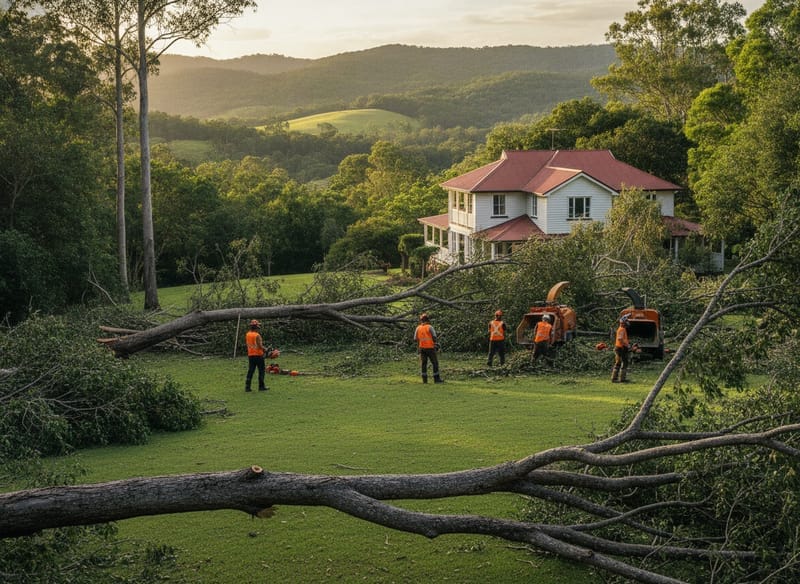
Branches are processed through our high-capacity chippers, and heavy wood is cut into manageable rounds.
We rake lawn areas clean of twigs and leaves, leaving your yard safe and orderly.
When severe weather lashes the Woden Valley, securing prompt and professional Storm Damage Tree Removal Hughes is critical to protecting your property and restoring safety. Hughes is renowned for its leafy 1960s streetscapes and mature private gardens, featuring massive exotics like claret ash alongside towering native yellow box and brittle gum. As these trees age in a drying climate, they become increasingly vulnerable to Canberra’s fierce westerly wind events, summer convective storms, and drought-breaking deluges that saturate the soil. Our team of highly qualified local arborists understands the devastation a sudden limb failure or entire root-plate collapse can cause. Whether a massive branch has crashed through a roofline during a wild storm, or a massive pine is left dangerously hung-up over your driveway, we deliver rapid, safe, and fully equipped emergency responses. We are fully versed in navigating the ACT Government’s strict emergency removal protocols, ensuring your property is made safe quickly, legally, and without adding unnecessary stress to an already overwhelming situation.
Storm-wrecked trees pose a uniquely volatile hazard. Unlike standard tree removal, a wind-thrown or lightning-struck tree is heavily compromised. Trunks are often under immense, unseen mechanical tension or compression, and heavy broken limbs—often referred to as 'widow-makers'—can remain suspended in the remaining canopy, ready to drop with the slightest breeze. Attempting DIY chainsaw work in these scenarios is exceptionally dangerous, frequently leading to severe injury, kickback accidents, or uncontrolled structural collapse that causes secondary damage to your home. Engaging under-qualified operators is equally risky. Operators lacking proper AQF Level 3 climbing qualifications or AS4373 pruning knowledge often resort to destructive 'lopping' to quickly clear a site. This practice leaves large, jagged stubs that invite rapid fungal decay and produce weak, dangerous epicormic regrowth, effectively turning a salvageable tree into a long-term hazard. Our team brings an entirely different approach. We utilise advanced rigging, EWP (cherry picker) access, and structural tree assessments to safely dismantle tension-loaded timber. By working strictly to Australian Standards, our climbers methodically remove the hazard piece by piece, protecting your home's structural integrity, preserving the health of remaining trees where possible, and ensuring your insurance claim isn't jeopardised by cowboy tactics.
Processing storm-damaged timber requires an entirely different technical skill set compared to standard tree felling. We deploy advanced arboricultural machinery and highly technical rigging systems to mitigate unpredictable loads and forces.
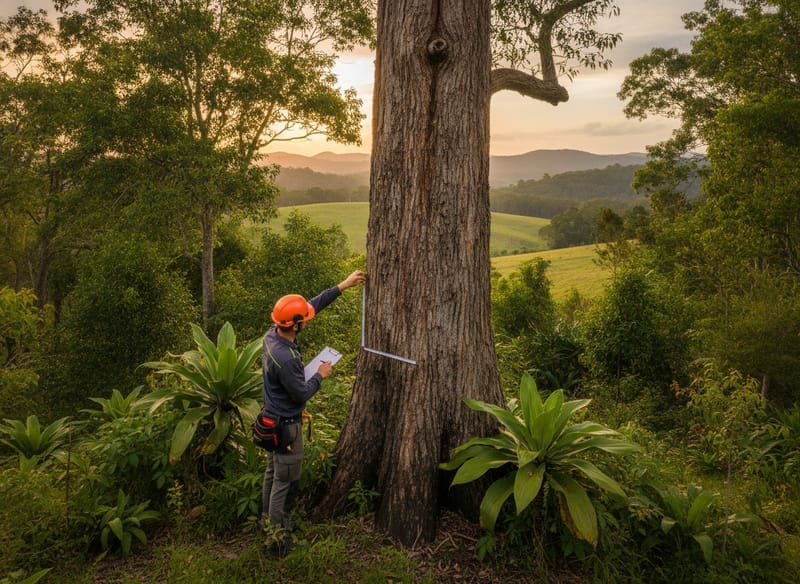
Upon arrival, our consulting arborists systematically tag trees by priority. Immediate hazards over dwellings or live power lines are addressed first, followed by secondary hazards like hung-up limbs. We capture detailed photographic evidence before commencing work to support your insurance claim.
For steep blocks on the Woden ridges where elevating work platforms cannot gain access, our AQF Level 3 climbing arborists use double-rope techniques. We install friction devices to safely lower heavy, shattered limbs of mature eucalypts away from fragile roof tiles and glass.
Wind-thrown trees and sprung root-plates require specialised cross-cutting. Using high-powered ground saws like the MS500i, our operators meticulously read the wood's tension to perform relief cuts, preventing aggressive chainsaw kickback and stopping logs from rolling uncontrollably.
When a massive regulated tree suffers total failure directly onto a house, we coordinate mobile crane lifts. This allows us to elevate multi-ton trunk sections vertically off the structure, entirely avoiding the secondary crush damage that standard felling would cause.
We rapidly clear site access using skid steers and process vast amounts of canopy debris through our 12-inch wood chippers. Heavy timber is loaded into our tipper trucks via HIAB loader cranes, returning your property to a safe, clean baseline.
Step 1: Emergency Response & Assessment. When disaster strikes, you need immediate clarity. Our team is dispatched to assess the damage at your Hughes property. We document the hazard with detailed photographs and provide a comprehensive, itemised quote. This documentation is formatted specifically to streamline submission to your insurance provider. Step 2: Securing Urgent ACT Approvals. In Canberra, any tree over 8 metres tall or wide is protected under the Urban Forest Act 2023. If a regulated tree poses an immediate danger, we do not wait 35 days for a standard permit. Instead, we contact Access Canberra directly for an urgent circumstances authorisation. This allows an authorised officer to approve the hazard removal on the spot, ensuring the make-safe work is fully legal and compliant. Step 3: Make-Safe and Dismantling Execution. Once clearance is granted, our trucks, chippers, and climbers arrive on-site. We establish a strict drop zone and isolate the area. Using EWP or rope access, our climbers systematically remove suspended branches and dismantle the main shattered trunk, rigging heavy wood away from your roofline and fencing. Step 4: Site Clearance and Reporting. Canopy debris is chipped on-site, and large logs are removed via tipper trucks. If remaining trees have sustained root-zone damage from the storm, our AQF Level 5 arborists can draft a post-storm tree management plan, guiding your property’s recovery.
Executing emergency tree work in Canberra requires absolute adherence to the Urban Forest Act 2023. We manage all urgent circumstances authorisations directly with Access Canberra so you are fully protected from compliance risks. Safety and liability protection are non-negotiable. Our business is fully insured with comprehensive public liability cover and mandatory WorkCover for all employees. Every cut our climbers make complies with AS4373 (Pruning of Amenity Trees), ensuring that surviving storm-damaged trees are treated with target pruning rather than destructive lopping, protecting their long-term viability.
Located on the flanks of the Woden ridges, Hughes features a mix of flat valley blocks and sloping, challenging terrain. The suburb backs onto the wooded reserves of Red Hill, bringing properties into direct contact with the ACT Bushfire Prone Area. This topography acts as a funnel for the severe westerly winds that roll off the Brindabellas, putting immense structural stress on aging broad-leaved peppermints, scribbly gums, and giant exotic deodar cedars. Managing Storm Damage Tree Removal Hughes means navigating these steep, narrow access points while dealing with massive, mature canopies. Because the ACT has a single, stringent set of criteria for tree protection—where almost every established tree is a regulated asset—you need an arborist intimately familiar with Canberra's specific legislation. We know how to identify high-risk limb failure in local eucalypt species, and we know exactly how to liaise with the ACT Government to authorise the removal of hazardous timber without delaying vital emergency repairs.
After the immediate storm debris is cleared, your property's remaining trees may still show signs of delayed stress, such as micro-cracking in the unions or lifting at the root plate. We highly recommend booking a follow-up assessment three to six months post-storm to ensure surviving trees have restabilised. If the ACT Government approved the complete removal of a protected tree, you will likely be subject to a canopy contribution agreement. This generally requires planting two replacement trees on your block. Our team can advise on sourcing AS2303-compliant nursery stock, recommending robust, climate-resilient species like Chinese pistachio or suitable native gums that will safely regenerate your property's canopy.
Storm damage cleanup costs in Hughes depend on the volume of fallen timber, presence of overhead hung branches, and machinery access.
We provide transparent, upfront quotes for all storm damage cleanup projects in Hughes.
We provide comprehensive storm damage tree services across Hughes and nearby Canberra suburbs.
Contact our team for safe storm damage tree removal and canopy cleanup in Hughes.
Get a Free Quote